Bible Study

Bible Study December 31, 2024

Revelation 2:10 

“Do not fear what you are about to suffer. Behold, the devil is about to throw some of you into prison, that you may be tested, and for ten days you will have tribulation. Be faithful unto death, and I will give you the crown of life.”

In his award-winning autobiographical novel Everything Sad is Untrue, author Daniel Nayeri talks about the persecution his mother faced when she converted from Islam to Christianity. She once hung a cross necklace in the back of her car and was told that if she didn’t remove it, she would be killed. In response, she hung an even bigger cross which covered half of the windshield.

Christian responses to persecution vary widely. We often interpret suffering as a warning light that something has gone wrong. Yet when we look to the Gospels, Jesus was abundantly clear that suffering, cross-carrying, and persecution would be normative for believers (see John 16:33, Matt. 16:24-25). In other words, it shouldn’t surprise us.

The church in Smyrna was suffering. They faced tribulation, poverty, slander, and the direct assaults of the devil. Some would be thrown into prison to be released only through martyrdom. Fear in the face of such danger is a natural human reaction, even though it betrays a fundamental distrust of God. Yet rather than berating them for their trembling hearts, John writes to encourage them: “Do not fear what you are about to suffer…Be faithful unto death, and I will give you the crown of life.” The crown spoken of here is a wreath or garland bestowed upon an athlete for winning a race. Through faith (believing, not achieving), Christians receive this crown, which means that death has lost its sting. As John says in the very next verse, “The one who conquers will not be hurt by the second death” (Rev. 2:11).

This crown of victory is only possible because of the crown of another, the crown of thorns worn by Jesus, the babe of Bethlehem, as he seated himself upon the wooden throne of the cross. It was precisely through suffering and persecution, not in spite of it, that he won the victory.

This manger-king would not escape a deep piercing (Isa. 53:5), nor will those closest to him (Luke 2:35). Yet, we can take heart. Instead of eliminating our present suffering, Jesus does something even better: He redeems it. It is no longer just a cause for anguish and despair but rather a divine tool used to forge us into the image of our Savior, who promises that life––not death––gets the final word.    

God Bless

Bible Study

Bible Study December 30, 2024

Hebrews 2:14b-15 

“…through death he might destroy the one who has the power of death, that is, the devil, and deliver all those who through fear of death were subject to lifelong slavery.”

You have no doubt already read about the connection between fear and death in this devotional series. Connecting the two in our daily lives doesn’t take much thought. Peel back the layers of fear in life, and we will eventually arrive at the reality of death.

But here, the author of Hebrews goes further––not only connecting fear to death but death to the devil and slavery. As slaves to sin, we find ourselves in fear of death and under the power of the devil.

Our sin results in death, which brings with it fear, all of which the devil knows and wields to his advantage. On and on, this cycle continues so that life itself must be defined by death.

Yet sin, death, and the devil––that unholy alliance which brings with it fear––don’t stand a chance against our God. Into this ongoing cycle of defeat, our God not only breaks in from the outside but breaks out from the inside. This is why the advent of Christ is so important. “For as by man came death, by a man has come also the resurrection of the dead. For as in Adam all die, so also in Christ shall all be made alive” (1 Cor. 15:21).

We are saved from those things we most fear because our God goes through them to the point that he suffers their defeat. This defeat, which takes place on the cross, ultimately makes him victorious when he rises from the grave. As Martin Luther says, Christ dies a “death against death” so that all that is connected to it—including our fears—is destroyed once and for all.

And now, his victory and all of its spoils are given to you. You are no longer cut off from his sight. You are no longer a slave to sin, death, or the devil. You are no longer one who lives in fear but one who lives in God’s lovingkindness, covered by his righteousness and with the promise of his eternal life. This is the gift of the Christ child for you.

Have a blessed day in Jesus.

Sunday @ Asbury Chapel

Sunday @ Asbury Chapel

We conclude our Advent Series this week with a message titled simply “Home” Over the past month we have shared a series of Advent messages. Our scripture reading today is taken from Luke 2:41 – 52 (English Standard Version). The message scripture is taken from Luke 1: Luke 1:39 – 45 & 56. If you could read it ahead of time it would help with the setting of the message.

Advent is over but what do we do with the Christmas story? Do we follow it, do we put it away for another year, what will you do with it? What will our church or any church do with it in 2025?

Join us at Asbury Chapel this Sunday at 9:30 AM for morning worship. We are located at the corner of Highways Y and W in Foley, MO. our physical address is 2704 South Highway W. Coffee is available along with donuts at 8:30 AM.

End the year in church and begin 2025 with a commitment to worship in church body.

Bible Study

Bible Study December 27, 2024

2 Timothy 1:6-7 

‘For this reason I remind you to fan into flame the gift of God, which is in you through the laying on of my hands, for God gave us a spirit not of fear but of power and love and self-control.”

With a name that means “God-fearer,” we would expect Timothy to be more courageous than he appears in this Epistle. Raised by a Christian mother, mentored by the Apostle Paul, with more than a decade of intense ministry experience under his belt, we might assume Timothy to be a fearless, battle-hardened veteran. Instead, what we get is a seasoned pastor still wrestling mightily with his own anxieties; uncertain and unsettled. The God-fearer was frightened, tempted to turn tail and run at the prospect of facing the same suffering as his long-time mentor. The dangers Timothy faced in Ephesus were real, not imagined. Ephesus had a history of chewing up and spitting out ministers of the gospel. Whether it was fierce resistance by the Jews (Acts 19:9), demons overpowering exorcists (Acts 19:16), or violent rioting in the streets (Acts 19:21-41), Ephesus was no place for the faint of heart.   

Whether the threat is real or imagined, physical or mental, near-at-hand or somewhere out there, our fears exert a powerful influence over us. They seek to drive us inward and downward, deeper into ourselves, rather than upward and outward towards God. Whenever we’re caught in the grip of our fears, the temptation will always be to look to our own resources to save ourselves. Self-dependence comes naturally. God-dependence does not. This is precisely why Paul writes: to speak a steadying gospel word to his wavering co-worker.

Instead of a spirit of fear, says Paul, God has given us a spirit of power, love, and a sound mind (self-control). Two things are apparent from this exhortation. The first is that God is never the source of fear. Anxiety and dread are never of the Lord but are instead alien to his nature and always come to us from the enemy. The second is that God has given us a stronger spirit, and it is threefold: power, love, and a sound mind. Perfect love, which casts out all fear (1 John 4:18), was displayed most fully at the cross, where Jesus died in victory over Satan and defeated death. Power (Greek dynamis, from which we get the English word for dynamite) explodes the insecurities that threaten to suffocate us since a greater force now controls us. And a sound mind comes from the peace of a healed relationship with the Prince of Peace, God himself.    

The same is true for you, dear Christian. Your namesake, too, is “God-fearer,” and power, love, and a sound mind are yours in Christ Jesus.

Have a blessed day.

Bible Study

Bible Study December 26, 2024

Colossians 3:15 

‘And let the peace of Christ rule in your hearts, To which indeed you were called in one body. And be thankful.”

Paul loves to compare the past and the present in his letters through his use of “were” and “are”: We were one thing, but now we are another. He does this even as he warns Christians still caught in the doings of the past, to remember who they are and live a new life. Something has happened to the Christian, and it’s serious. A change has happened, which leads to more changes, which are fruit and not root.

In this chapter, Paul writes about the Christian life. It’s the Christian life not just because the Christian lives it, but even more because it’s lived in Christ. Christ is our life, and our lives are hidden in him until he reappears.

You were. You were a lot of things. You may still feel like you are those things. You may still sometimes live like you are those things. You, however, are not those things. You are something new in Christ. You are, here and now, a new thing, as new as when you first became it. You are God’s chosen one, holy and beloved, together with all the redeemed.

You are Christ’s. This is what Christmas is all about.

That “were” is a pesky old pest, though. It clings to our ankles, hangs around our necks, lingers in the corners of our minds, whispers in our ears. That “were” doesn’t want to die, even as it’s dead already. That “were” wants its throne back, even though that throne belongs to Christ. And that “were” isn’t confounded by futility. Its whole being is futile, and so it never gives up until it will have to because Christ will say “Enough!” and all things will be made new, perfectly, forever.

You are God’s own child, together with many others, with whom you are one body. You were something else at one time, and that something else still tries to claim and rule you, but you are not what you were. You are God’s own child. You are the temple of Christ. You are. And that is your peace, the peace of Christ, the forgiveness of sins, which does away with all the “were” and plants you firmly in the “are” of Jesus: in true life, in harmony with your Creator and with his children. Be thankful, because that is what you are.

Bible Study

Bible Study December 24, 2024

Colossians 1:19-20 

“For in him all the fullness of God was pleased to dwell, and through him to reconcile to himself all things, whether on earth or in heaven, making peace by the blood of his cross.”

Do you ever wonder how God feels about the incarnation? The eternal God, creator of all things, righteous and holy, took on flesh and became man. Surely, the best you could hope for describing God’s attitude towards this event would be that he was willing. But no. Paul tells us that he was pleased to do it. That should leave you amazed. Why would God be pleased to take on flesh and die for people who hate him? That a father would be willing to die for his child is something we understand. But Jesus is pleased to die for his enemies to make them children of God. This tells us something important: God is all about peace and reconciliation.

In Hebrews 12:2, we are told that Christ endured the cross “for the joy set before him.” That joy is creation’s reconciliation and peace with God. This promise of peace is the message that was spoken to Adam and Eve after the fall. This is the message delivered to Abraham, Isaac, and Jacob. This is the message placed in the mouths of the Old Testament prophets and sung by angels to shepherds. And this is the message Christians proclaim and cling to today. Out of unfathomable love, God was pleased to become man and shed his blood to bring peace and reconciliation to the world. Christmas is the declaration that God is not only willing to make peace with you, he is pleased to do it.

God Bless

Bible Study

Bible Study December 23, 2024

Philippians 4:7 

“And the peace of God, which surpasses all understanding, will guard your hearts and your minds in Christ Jesus.”

What are you anxious about? Take a moment and give the question some thought. Maybe you are not anxious about anything you are certain God is in control of all things. I would ask you to pray a short prayer for those you know are troubled this Christmas season.

Perhaps you woke up to anxieties this morning, or you laid down with them last night. Perhaps they have to do with you personally. Maybe you feel anxious about the well-being of a loved one or about a fraught relationship. You might even feel anxious about the state of something larger than yourself: your job, your church, your country. Whatever it is, Paul tells us in Philippians 4:6, “Do not be anxious about anything.”

To end here, however, it would be to leave us all in judgment, for we have just established the ongoing reality of anxiety that pervades our lives.

The good news is that Paul doesn’t end on this command. Instead, he gives us one more command, and then finally, a word of proclamation: Do not be anxious, submit everything in prayer; in other words, “Cast your cares on the Lord” (Ps. 55:22). Do these things not for the peace of God, but because of the peace of God.

 This is a peace, which is Christ himself. And as Christ, our Savior who came to live, die, and rise for our sake, this peace transcends all understanding. If such peace were limited to our understanding, it would be limited to our experience and feelings. But while we are grateful when our lives and feelings reflect this reality, Christ’s peace will always be more trustworthy than the changing winds of our circumstances. He is a peace that meets us in our need, sustains us in our suffering, and answers our problems. He is a peace that has the last word on who we are. He is the Prince of Peace, born for you. This is the good news by which he guards our hearts and minds.

Sunday @ Asbury Chapel

Sunday @ Asbury Chapel

On the twenty-second of December we will light the candle of love. God’s love for us is the whole reason we celebrate Christmas. Christ came to save the world out of love of the Father for His children.

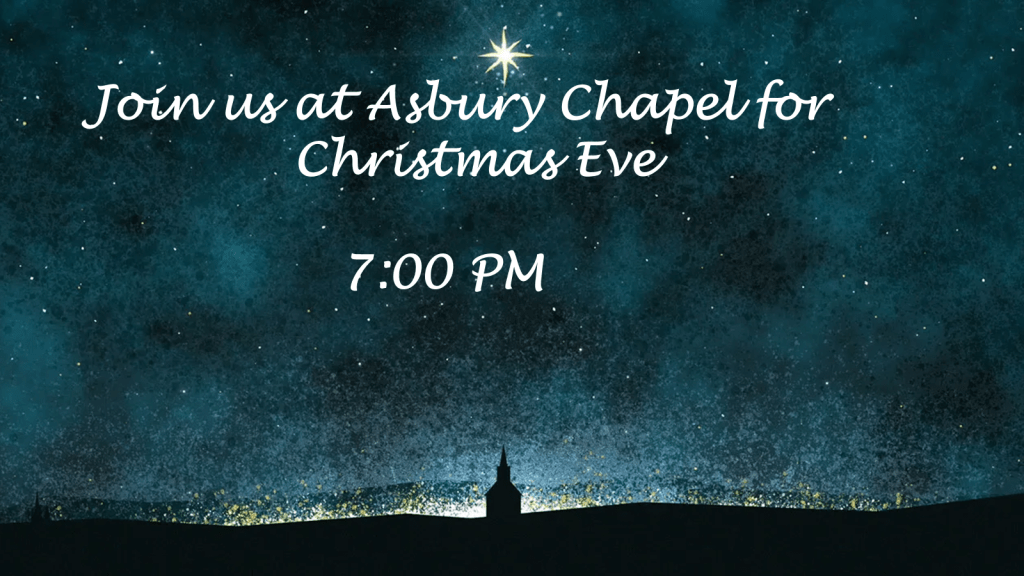
Sunday we look at the subject of “Promise.” We have looked over this Advent season of four words and we conclude our series on Tuesday as we invite you to join us for our Christmas Eve service which begins at 7:00 PM. But first this Sunday our topic is “Promise.”

Sunday our text is taken from Micah chapter 5 verses one through four.

What Micah found was moral weakness in the leaders they hated good and loved evil. The leaders were planning to take farms, homes, and inheritance from the people and carry out injustice toward the people in the land. But in the midst of all the bad news Micah has some good news to bring to the people.

Join us at 2704 South Highway W in Foley., MO. for worship beginning at 9:30 AM. Coffee is hot and on around 8:30.

Like Us on Facebook: facebook.com/asburychapel.org or if you can find us on Facebook if you are unable to attend at facebook.com/asburychapel.org.